


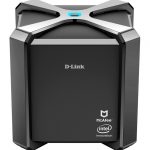
D-Link DIR-2680 is an Intel-powered Wi-Fi Router with McAfee Secure Home Platform

We are living in very scary times, and I'm only referring to technology. Concerns about nuclear war and unstable world leaders aside, our computers and devices are like Swiss cheese nowadays thanks to Spectre and Meltdown. Hell, there are hardcoded backdoors in consumer devices! What a sad state of affairs...
If you want to help keep your home network safe, a quality router is always a smart purchase. Not only do you want something that is reliable, but it should be from a reputable manufacturer that issues regular updates. One such company is D-Link, and today, it unveils a new 802.11ac wireless router that leverages the McAfee Secure Home Platform to keep you safe. Called "DIR-2680," it features an absolutely gorgeous industrial design that, quite frankly, makes it appear as something other than a router entirely.
Western Digital 'My Cloud' devices have a hardcoded backdoor -- stop using these NAS drives NOW!

I must be honest -- I am starting to become fatigued by all of the vulnerabilities and security failures in technology nowadays. Quite frankly, between Spectre and Meltdown, I don't even want to use my computer or devices anymore -- I feel exposed.
Today, yet another security blunder becomes publicized, and it is really bad. You see, many Western Digital My Cloud NAS drives have a hardcoded backdoor, meaning anyone can access them -- your files could be at risk. It isn't even hard to take advantage of it -- the username is "mydlinkBRionyg" and the password is "abc12345cba" (without quotes). To make matters worse, it was disclosed to Western Digital six months ago and the company apparently did nothing until November 2017. Let's be realistic -- not everyone stays on top of updates, and a backdoor never should have existed in the first place.
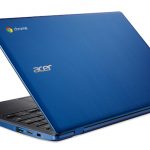
This is the new Acer Chromebook 11
Many people diss Chromebooks because they simply don't understand them. No, Chrome OS -- the operating system that powers these laptops -- is not just a glorified web browser. Actually, the OS is a full Linux distribution that is both extremely secure and easy to use. True, they can be deficient for some tasks, such as video editing and hardcore gaming, but let's be honest -- not everyone has those needs. If everything you do is in a browser -- email, web surfing, social media, YouTube, Netflix, etc. -- there is no reason to run Windows and open yourself up to malware and other bad things. Hell, Chromebooks even have Microsoft Office support these days!
Today, Acer unveils its latest Chromebook 11, and it is absolutely beautiful. The 11.6-inch Chrome OS laptop comes with 4GB of RAM by default, plus your choice of either 16GB or 32GB of onboard storage. There is even an optional touch-screen variant, which will come in handy for its Google Play Android app support. Road warriors will appreciate the impressive 10-hour battery life. The Celeron processor is passively cooled, meaning there are no fans to bother you with noise.
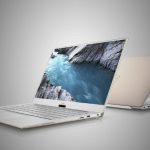
Dell releases Ubuntu Linux-based XPS 13 Developer Edition (9370) laptop
If you want a computer pre-loaded with a Linux-based operating system, you can never go wrong with System76. After all, that company focuses entirely on Linux -- it does not sell Windows machines at all. Hell, System76 even maintains its own Ubuntu-based operating system called Pop!_OS. By supporting that company, you are also supporting the overall Linux community.
System76 is not the only company selling Linux-powered computers, however. Despite being a major Microsoft partner with Windows, Dell also sells desktops and laptops pre-loaded with Ubuntu. One of the company's most impressive computers is the svelte XPS 13 laptop. Dell sells a version with Ubuntu that it dubs "Developer Edition," but non-developers can, of course, use it too. Today, the company announces the the 7th-generation version of this notebook. The 9370, as it is called, can be purchased immediately.
OnePlus 5T Sandstone White is coming -- here's how to get the limited-edition Android smartphone

One of the fun aspects of Android is that you get to choose from many different devices. Unlike Apple iOS, where you are fairly limited, Google's operating system can be had on many phones and tablets, from companies like LG, Samsung, HTC and more. Unfortunately, unless you buy a Pixel or Nexus device, you often don't get a "pure" Android experience. Not to mention, community support can be limited due to locked bootloaders and other nonsense.
That's why the OnePlus devices have been such a breath of fresh air. These phones are no-nonsense, with purposeful design, and a fairly pure Android OS experience. Best of all, there is a wonderful community for support. Not to mention, they are affordable too. Today, the company announces that its latest flagship, the OnePlus 5T, will soon be available in a very limited edition color -- Sandstone White. Despite having the same specifications and just being a new color, the company says the phone "is the most complex device we have ever built."
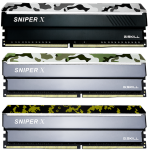
G.SKILL unveils camouflage-inspired Sniper X DDR4 RAM
When it comes to computer building, yes, looks do matter. It sort of annoys me when people say a PC's appearance is meaningless. The same could be said about cars, clothes and houses -- why bother having different colors? They should all be gray! True, they would essentially function the same, but it would be rather boring too, right? So no, there is nothing wrong with taking pride and having fun with your computer's appearance -- both inside and out.
To drive that point home, G.SKILL launches new DDR4 RAM sticks under the "Sniper X" branding. This memory stands out because of its appearance. You see, the company has given it really cool camouflage-inspired heatsinks. Appearance aside, kits can be had in capacities up to 128GB with speeds up to 3600MHz -- it is not form over function!
Meltdown and Spectre vulnerabilities bring the computing apocalypse, and yes, you are screwed

Earlier today, we reported on some shocking news -- there is a serious vulnerability that affects Intel processors. To make matters worse, patching that vulnerability -- now known as "Meltdown" -- would cause an up-to 30 percent performance degradation. Yikes!
If you have an AMD processor, you are safe, right? Yes, but not really. You see, yet another vulnerability has been revealed that impacts all modern processors, such as those from Intel, AMD, and yeah, even ARM chips. This vulnerability is called "Spectre," and it has the potential to put the entire technology industry into a tailspin. Seriously, folks, this is very bad -- it is like the computing apocalypse. What's the worst that could happen? Well, your data and passwords could leak and you are almost powerless to stop it.
Linux Mint 19 named 'Tara'

Unfortunately, 2017 was not the much-fabled year of the Linux desktop. Hell, that might not ever happen. With Windows 10 being such a disappointment for many, however, it is definitely a possibility. Maybe 2018 will be the year...
One such desktop operating system that consistently delights users is Linux Mint. Today, we get some information about the upcoming version 19. The biggest news is that it will be called "Tara." If you aren’t aware, the operating system is always named after a woman.
Samsung CJ791 is world's first curved Thunderbolt 3 QLED display
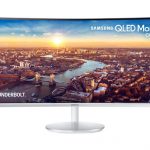
Curved televisions are gimmicky and an overall bad idea. I bought a curved 4K TV a couple years ago, and while I do like it overall, it has a big negative -- it shows a lot of glare when the sun comes through the windows. Ultimately, the curved aspect doesn't seem to provide much (if any) value over a flat set when sitting on my couch.
Where curved displays are wonderful, however, is for computer monitors. When you are sitting closer to a display, such as at a desk, it provides a more immersive experience -- it is great. Today, Samsung unveils what it claims is the world's first curved Thunderbolt 3 QLED display. The 34-inch "CJ791," as it is called, features a 3440x1440 resolution, wide 21:9 aspect ratio, and four milliseconds response time.
Lindows rises from the grave! Freespire 3.0 and Linspire 7.0 Linux distros now available

About 16 years ago, a for-pay Linux distribution caused quite a stir all because of its name -- Lindows. Yes, someone actually thought kicking the billion dollar hornets nest that is Microsoft by playing off of the "Windows" name was a good idea. To be honest, from a marketing perspective, it was brilliant -- it got tons of free press. Microsoft eventually killed the Lindows name by use of money and the legal system, however. Ultimately, the Linux distro was renamed "Linspire." Comically, there was a Lindows Insiders program way before Windows Insiders!
After losing the Lindows name, the operating system largely fell out of the spotlight, and its 15 minutes of fame ended. After all, without the gimmicky name, it was hard to compete with free Linux distros. Not to mention, Richard Stallman famously denounced the OS for its non-free ways. The company eventually created a free version of its OS called Freespire, but by 2008, both projects were shut down by its then-owner, Xandros. Today, however, a new Linspire owner emerges -- PC/OpenSystems LLC. And yes, Lindows is rising from the grave -- as Freespire 3.0 and Linspire 7.0!
Plextor launches M9Pe NVMe PCIe gaming SSD
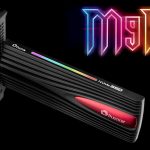
It’s 2018, and there will likely be a lot of new hardware to excite and delight computer builders this year. In 2017, we saw solid state drives continue their climb in popularity -- a trend that will absolutely continue in the new year.
Today, Plextor launches a new solid state drive with a focus on gaming. The M9Pe series, as it is called, is an M.2 NVMe SSD drive that will be sold in capacities up to 1TB. It uses 64-layer 3D NAND Toshiba flash and the Marvell 88ss1093 controller.
How to use Kodi to play classic video game ROMs -- Mario, Sonic, Zelda, and more!

As someone who was born in the 1980s, I experienced the golden age of video games. While the graphics were archaic by today's standards, the games were much more fun than the ones of today. People tend to forget that fun is the most important aspect of video games -- sound and graphics be damned. You bought a completed game and there were no updates, DLC or loot crates to be had. It was an amazing time.
Luckily, enjoying these classic games of yesteryear is very easy thanks to emulators. While the legality is a bit sketchy, you can download thousands of retro games (ROMs) and play them on your PC with near-flawless results. To make things even more convenient, the Kodi media center can now be used to play these ROMs. If you want to try this for yourself, I am happy to say you can do so immediately. The folks over at TVAddons have created a very useful guide.
Ring in New Year 2018 with Manjaro Linux 17.1.0

Today is the big day -- New Year's Eve! Tonight, many people will celebrate ringing in the new year at midnight. They will drink champagne, dance, and generally have a fun time.
If you are a nerd like me, however, you won't be leaving the house. Instead, you will probably be watching Dick Clark's New Year's Rockin' Eve with Ryan Seacrest while eating low-quality frozen hors d'oeuvres -- there is no shame in that, though. This year, there is actually something very fun you can do while sitting on your couch -- install a Linux distribution! You see, Manjaro Linux 17.1.0 is now ready for download. Hell, installing an Arch-based Linux distro is better than going to a party, right?
The New York Times pulls support for its Windows Phone app

Microsoft's Windows Phone was actually pretty terrible. While it had some redeeming qualities, the now-failed platform was quite deficient compared to iOS and Android. Only the absolute biggest Microsoft loyalists truly embraced it, and even they have mostly moved on. Yeah, other consumers bought Windows Phone devices, but likely just because some of the models were so damn inexpensive -- it was like purchasing a feature-phone. Hell, the NYPD famously regretted choosing Microsoft's mobile OS.
That's why it is surprising that The New York Times -- one of the most important news outlets in history -- is still supporting a Windows Phone app. Well, I should say it was supporting it. You see, in a rather unceremonious announcement, the company says it is ending support for that app.
ADATA launches UV230 and UV330 retractable USB flash drives

USB flash drives are becoming less popular thanks to the cloud. If you need to access a file on the go, using a cloud-based storage service like Dropbox is extremely convenient. Unlike a flash drive, you don’t have to worry about losing it.
These diminutive drives definitely still have a place, though. For instance, I use them regularly for installing Linux distributions and Windows 10. Not to mention, they are wonderful when an internet connection is not available. Today, ADATA unveils two new models. Both use USB Type-A for connectivity, but one uses USB 3.1, while the other uses the slower USB 2.0.
Brian's Bio
Staff Journalist
Ethics Statement© 1998-2026 BetaNews, Inc. All Rights Reserved. Privacy Policy - Cookie Policy.