

Intel Security releases EFI rootkit checker for MacBooks after CIA hacking leaks


The Vault 7 leaks this week suggest that the CIA has been able to exploit vulnerabilities in a wide range of popular hardware and software, including Windows, macOS and Linux. One of the suggestions is that the agency produced EFI (Extensible Firmware Interface) rootkits for MacBooks called DarkMatter.
To help calm the fears of MacBook owners, Intel Security has pushed out a tool to check for such rootkits. Apple issued a statement earlier this week indicating that it had addressed "many of the issues" exposed by WikiLeaks, but Intel Security's further intervention will bring some peace of mind to concerned users.
Ever Sentinel notifies you when companies change privacy policies or terms and conditions

Changes to terms and conditions or privacy policies happen all the time, and this presents a few problems for consumers. As well as having to negotiate through the often impenetrable language used in these documents, it can be near impossible to work out what has changed, and what the implications are. This is where Ever Sentinel can help.
The service monitors the terms and policies for a number of popular websites and services, and not only alerts you when they change, but highlights exactly what has changed. It's part of a drive to encourage greater transparency in terms and conditions and privacy policies, and it's free for you to use to keep yourself informed.
iClever Tri-folding Wireless Keyboard with Touchpad IC-BK08 [Review]

Around a year ago I took a look at the iClever Tri-folding Backlit Bluetooth Keyboard, having previously examined the iClever Portable Foldable Bluetooth Keyboard. The latest addition to the range follows in the footsteps of its predecessors, but this time boasts a trackpad.
This is a Bluetooth keyboard that can be configured to connect to up to three devices -- phones, tablets, laptops, and so on. The keys are nearly full-sized (just 9 percent smaller than normal), and the right-hand side of the fold-out unit is occupied by a laptop-style trackpad that allows for easier control of the device you connect to, and eliminates the need to carry a mouse as well.
0patch pushes out another Windows patch, but will leave the real work to Microsoft

Last week 0patch produced what was described as the first 0-day patch for Windows in lieu of Microsoft's usual Patch Tuesday release. It came after Google revealed a pair of vulnerabilities affecting IE/Edge and Windows.
Having addressed the problem in Windows, 0patch is at it again, this time patching the "type confusion" bug (CVE-2017-0037) that plagues Internet Explorer and Edge. This patch is described as an attempt to "release a simple temporary patch that blocks an attacker than try to create a perfect patch", and it's available for anyone who is willing to place their trust in third-party patching.
Plex Cloud lets you access your media when your server is switched off

Plex has introduced a new feature that makes it possible to store media files in the cloud.
Plex Cloud has been in beta for some time, but it's now available to anyone with a Plex Pass subscription, and it works with Dropbox, Google Drive and OneDrive.
Google is bringing add-ons to Gmail

It's something that Gmail users have been asking for for ages now -- the ability to use third-party add-ons to extend the capabilities of the email service. Today at its Cloud Next conference in San Francisco, Google announced that plugins that can integrate with Gmail are on their way.
While "add-ons" are already around, they exist in the form of browser extensions. What Google is talking about now is native add-ins that are not dependant on Chrome extensions, and will therefore work online in any browser, on just about any device -- including iOS and Android.
Julian Assange says WikiLeaks will share CIA hacking tools from Vault 7 with technology companies

Technology companies will be given access to the CIA's hacking tools revealed earlier in the week, Julian Assange said today. The WikiLeaks founder said that full details of the exploits used by the CIA would be shared with a view to allowing companies to patch the security holes.
Apple has already said that it has fixed many of the iOS vulnerabilities mentioned in the document cache, and we know that the CIA exploited vulnerabilities in all major operating systems as well as weaponizing numerous popular programs. While WikiLeaks has made certain details of the CIA's hacking tools public, it intends to share them in their entirety privately so software developers can create patches.
FBI investigates CIA leaks, Comey says 'There is no such thing as absolute privacy in America'

The FBI and CIA are working together on a joint investigation into the Vault 7 document cache published by WikiLeaks that supposedly reveals the CIA's hacking tools. Many of the companies mentioned in the documents for having exploitable vulnerabilities -- including Apple, the Linux Foundation, and Microsoft -- have spoken out about the leaks, but it has taken some time for the CIA itself to respond.
Speaking to the BBC, a CIA spokesperson said: "The American public should be deeply troubled by any Wikileaks disclosure designed to damage the intelligence community's ability to protect America against terrorists and other adversaries." FBI director James Comey has also spoken about the lack of privacy that now exists in the US.
How to remove the 'Edit with Paint 3D' option from Windows 10 Creators Update context menus
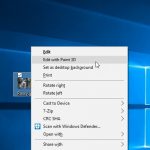
If you've been an avid installer of Insider builds of Windows 10 (or you're reading this after the release of Windows 10 Creators Update) you'll no doubt be aware of Paint 3D. Microsoft's foray into 3D design is interesting, but it's certainly not for everyone.
In reality very few people are likely to actually make serious use of Paint 3D, but despite this Microsoft has chosen to throw an Edit with Paint 3D option into the context menu that appears when you right click on an image file. You probably don’t want or need this, so here's how to get rid of it.
Vault 7 fallout: Linux Foundation says it's "not surprising" Linux is targeted

In the wake of WikiLeaks' Vault 7 CIA leaks, Apple has been quick to point out that vulnerabilities mentioned in the documents have already been addressed. Microsoft and Samsung have said they are "looking into" things, and now the Linux Foundation has spoken out.
Nicko van Someren, Chief Technology Officer at The Linux Foundation says that while it is "not surprising" that Linux would find itself a target, the open source project has a very fast release cycle, meaning that kernel updates are released every few days to address issues that are found.
Consumer Reports to factor privacy and security into its technology reviews

There is much to consider when buying a piece of technology, but price and suitability tend to be at the top of most people's lists. In recent years, however, there has been an increased interest in privacy and security, and this is something that renown reviewer Consumer Reports is going to start taking into consideration.
Consumer Reports most recently hit the headlines for deciding not to recommend the new MacBook Pro (although it later changed its mind), and now the non-profit has teamed up with a number of privacy, security, and consumer rights organizations with a view to creating a new digital standard for products to live up to. The aim is to put data security and privacy first, just as many consumers are starting to do.
How to disable ads in File Explorer in Windows 10

Microsoft has used Windows 10 as a vehicle for advertising in a variety of ways over the months since its launch. We've seen ads in the Start menu, via taskbar popups and on the Lock screen; now you can find them in File Explorer.
Users have reported the appearance of advertisements for Microsoft's own OneDrive service as they browse the contents of their hard drive(s). You may well think that this is unacceptable, so we'll show you how to disable ads in File Explorer. Even if they haven’t shown up for you yet, there's no harm in taking preventative measures.
Microsoft and Samsung react to Vault 7 CIA leaks -- Google, Linux Foundation and others remain silent

The Vault 7 document and code cache released yesterday by WikiLeaks revealed that many big software companies were being actively exploited by the CIA. Apple, Microsoft, Google, Samsung, and even Linux were all named as having vulnerabilities that could be used for surveillance.
Apple was one of the first of the companies mentioned in the documents to speak out and address concerns and security. But while the iPhone manufacturer has quickly indicated that it has fixed "many" of the vulnerabilities, Microsoft and Samsung have merely said they are looking into the issues raised. Other companies and groups mentioned have made no comment at all.
Apple says it has fixed 'many of the issues' exposed in WikiLeak's CIA hacking data dump

Yesterday WikiLeaks unleashed Vault 7 online, revealing a wealth of information about the CIA's hacking tools and techniques. Included in the data dump was the suggestion that the CIA was actively exploiting vulnerabilities in iOS and other software to listen in on people. Apple has responded by saying that "many" of these security holes have been fixed.
Importantly, the company is unable to say that all of the vulnerabilities being used -- or that have been historically used -- by the CIA have been addressed, but it does insist that it "will continue work to rapidly address" problems that are found. A number of iOS security flaws have been exploited by the CIA to surveil individuals, or even take remote control of devices.
Take care with Facebook Lite -- it could be stealing your data and installing malicious apps

It's no secret that Facebook can be a real hog, both in terms of data and battery usage. To combat the problem, Facebook released a cut-down version of its mobile app in certain markets called Facebook Lite; it also followed that up more recently with Facebook Messenger Lite.
The problem with Facebook Lite is that it's not available everywhere through Google Play. For people keen to get their hands on the app, there are plenty of app repositories online offering it for download. But not all repositories are equal, and some are serving up a tainted version of Facebook Lite that's laden down with spyware -- specifically Android/Trojan.Spy.FakePlay.
Sofia Elizabella's Bio
Sofia Wyciślik-Wilson is a queer, transgender journalist based in Poland. She has been writing about technology for more than two decades, and after years working for magazines, her writing moved online. She is fueled by literature, music, nature, and vegetables. You can find her on Bluesky and Mastodon. If you like what you read, you can Buy her a Coffee!
© 1998-2026 BetaNews, Inc. All Rights Reserved. Privacy Policy - Cookie Policy.