


Office 365 for Government puts Microsoft squarely on Google's turf


Microsoft is making a play for the lucrative government sector, releasing Office 365 for Government on Wednesday. The service is much like the standard product, including Exchange Online, Lync Online, SharePoint Online and an option to purchase a local version of Office Professional Plus.
Where the government version of Office 365 is different is how it stores data. Government agencies typically require a good deal more security, so all data is stored in a "segregated community cloud". This means data for government customers will be completely separate from other Office 365 users.
Siri sucks


Yesterday, during the annual D conference, Apple CEO Tim Cook said that the company is "doubling down" on Siri. Improvements are coming -- promised without admission of problems, although complaints about them are many. Then there's the lawsuit claiming Siri fails to meet advertised capabilities. You could interpret Cook's promise as concession Siri sucks or that Apple is preparing to take on Google in search. I see it both ways.
Five years ago, Apple supercharged the smartphone category with a more natural user interface. Suddenly, there was a new way to interact with a mobile phone that was seemingly magical. Humanness made the original iPhone stand apart from all competitors, and Apple used a variety of sensors to imbue the quality. Touch, and its intimacy, and the way the handset responded to your proximity gave it the human quality. But Apple has done little since, other than Siri, which does add a little more humanness to iPhone 4S. She adds personality and extends the mobile user interface to another more important than touch: Voice. Problem: There's something inhuman about Siri's often frustrating responses to questions.
BetaNews giveaway: One year of premium Safe Shepherd 'Privacy-as-a-Service'


Venture-backed startup Safe Shepherd is a service we can really get behind. Users sign up and enter their personal information (personal names or aliases, email addresses, phone numbers, mailing addresses, etc.) into a profile, and Safe Shepherd locates that information on data broker websites and then erases it.
It helps protect your information against sites like BeenVerified.com, Radaris, Spokeo, and RapLeaf, which scrape whatever data they can find and sell it to marketers, or even worse, to potential identity thieves.
Deskspace turns your desktop into a 3D virtual cube


You don’t have to have too many programs running to start to find the amount of space available on your desktop to be a little tight. Rather than rushing out to buy a larger monitor, you might want to think about trying a virtual desktop tool. There are plenty of these apps to choose from, many of which are very similar top each other, but DeskSpace stands out from the crowd with a delightful 3D interface.
The program provides you with six virtual desktops, each of which is the face of a cube. You can navigate from desktop to desktop by dragging your way around the cube faces in three dimensions, but you also have the option of jumping straight to a particular workspace by using a keyboard shortcut or a menu. This is not the first time that a three dimensional concept has been used in virtual desktops, but here it has been beautifully implemented.
API Monitor 2.0 may only be alpha, but it gets the job done


When you need to track an application’s behavior then Sysinternals Process Monitor is a great place to start. In a click or two you can be watching the target program’s file, Registry and process-related activities, perfect for troubleshooting all kinds of odd problems.
Of course Process Monitor is watching only a relatively small number of Windows API calls, in an effort to keep things simple. These are well chosen, and will help you solve most common issues. But if your problem relates to something the program doesn’t track, an Internet function, say, then you might want to try a more powerful troubleshooting tool, like API Monitor.
CyberLink revs PhotoDirector 10, PowerDVD 12 and MediaShow 6 for AMD A-Series APUs


Taipei, Taiwan-based CyberLink has issued updates for its flagship media viewing and editing products, including CyberLink PowerDirector 10 Deluxe, CyberLink PowerDVD 12 Pro and CyberLink MediaShow 6 Ultra.
The updates are all designed to take full advantage of the new second-generation AMD A-Series APUs (Accelerated Processing Units) recently launched by AMD. APUs integrate graphics and CPU chips on to a single die for performance gains and are currently available on new notebooks, with desktop chips due later this year.
What would you pay for a 7-inch, quad-core Asus-made, Googe-branded Android 4.1 Nexus tablet?

Rumor stories are uncommon here at BetaNews, and rare when we don't get the information ourselves. But Android Police has got one so tasty and so in line with others, I can't resist. In less than one month, Google could debut the highly-anticipated Nexus tablet, produced in conjunction with Asus and packing quad-core Tegra 3 processor and Android 4.1. The only question, if rumors prove to be true, is price. What would you pay for a 7-inch Asus-made, Googe-branded Nexus tablet?
David Ruddock reports evidence from Rightware's Power Board benchmark and Android Police server logs showing instances of Androd 4.1 and Nexus devices. But the benchmark tool is more revealing: 1.3GHz nVidia Tegra 3 quad-core processor, 1280 x 768 resolution display, Google brand and product name Google Asus Nexus 7. That's hardly a smoking gun. Asus and Google could be testing a prototype device, or even several. But given that Google I/O starts June 27, developers received tablets there last year and the search giant promised a Nexus tablet in about six months half a year ago, the discovery is too credible to ignore.
SysExporter 1.60 grabs data stored in otherwise inaccessible Windows controls

NirSoft has released SysExporter 1.60, the latest version of an interesting tool that allows you to grab data stored in otherwise inaccessible Windows controls: list views, tree views, list boxes and more. And if you’ve not used the program before this may sound a little odd, but SysExporter does have plenty of practical applications.
Suppose, for example, you wanted to make a note of the video files supported by VLC Media Player. You can see them by clicking File > Open and opening the file type list, but there’s no way to copy that text to the clipboard. And so you either have to retype them manually, or waste time browsing the documentation or website in the hope that there’s a more accessible list elsewhere.
Adobe rolls out Lightroom 4.1 and Camera Raw 7.1 updates

Graphic design software company Adobe on Wednesday launched the final release versions of its Lightroom 4.1 photography software and Camera Raw 7.1 Photoshop plug-in.
These updates add some new features, correct some bugs, and broaden device support.
Flamer is too effective to be ignored


The news and specualtion around Win32/Flamer is extensive and complex. While it is understandable that what appears to be a sophisticated threat found in several regions, some of them particularly politically sensitive, has excited so much interest. Conflicting conjecture and confusion over the "ownership" of the detection is muddying the waters somewhat.
According to the Iran National CERT, it had detection (but not removal) for the malware in early May, but Kaspersky claims it’s been in the wild since March 2010. This seems to be the same malware theat that the Laboratory of Cryptography and System Security (CrySyS) in Budapest calls sKyWIper (which they believe may have been active for 5-8 years or even longer). However, it looks as if those assumptions on timing are incorrect: module compilation dates have been manipulated, presumably in order to hamper researchers in some way.
Amazon launches Prime video streaming on Xbox 360

Amazon has been in the business of streaming video since 2008, and has offered its streaming on demand platform as a subscription service for a little less than a year-and-a-half. Today, Amazon's Prime Instant Video service launched on the venerable Xbox 360.
Xbox Live Gold members have had access to Netflix and NBC Universal content on their 360s for nearly four years, and in that time, the service has grown to include ESPN, Crackle, Epix, SyFy, Hulu Plus and more. Today's addition of Amazon Prime on Demand adds approximately 17,000 titles to the mix.
Is Israel behind the 'Flame' worm?

Security researchers are warning of what they call one of the most sophisticated worms to date, and believe that this time, the worm may be the work of a nation-state rather than hackers. Called "Flame", the Trojan has hit Middle Eastern countries particularly hard, most notably Iran.
According to Kaspersky, Flame is capable of stealing "computer display contents, information about targeted systems, stored files, contact data and even audio conversations". The worm appears to be targeted to specific computers, likely indicating its creators are searching for specific information.
Is Samsung Chromebook Series 5 550 worth spending $549?

Google and Samsung couldn't have done more to hide the second-generation Chromebook and new Chromebox during Consumer Electronics Show 2012 in January. They're cloaked no longer, as I explain in my "Samsung Chromebook Series 5 550 first-impressions review". The products launched today, and they're worth a look. But is the new Chromebook worth buying?
Everyone should ask first about performance, because by the specs Samsung's new Chromebook is an under-performer -- Celeron processor in an Core i-processor world. But there are different measures of performance, and only one really matters: Is it good enough for what it's meant to do? I partly answer the question in my review, but the topic is so important for this computer I've dedicated another post just to it. Quick answer: Performance is good enough. However, price-performance is another matter.
Samsung Series 5 550 Chromebook first-impressions review
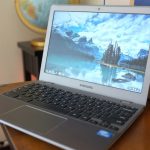
Today, Google and Samsung officially launch the second-generation Chromebook, starting with the Series 5 550, which like its predecessor comes in WiFi-only and 3G combo models. I had the pleasure of using the new Chromebook for the past week as my only PC. The overall user experience is surprisingly satisfying and refreshing. In a computer market dominated by Mac and Windows, Chromebook is freedom from duopolies that define the experience within walled gardens and around desktop applications. But changes introduced with Chrome OS 19 make the user experience much more desktop-like, as Google cedes some of the browser motif for familiarity and usability, with multitasking being high among the reasons.
If you read no further, the answer to your question is this: Yes, you can use Chromebook Series 5 550 as your primary, and only, PC. Google has succeeded offering online and offline capabilities balanced to most computing needs, while keeping cloud benefits primary but seamlessly integrated. For two months last summer, I used the original Samsung Series 5 Chromebook as my primary PC, in the first weeks and as my only one later on. I'll repeat the experiment at least through the end of June, and I might not go back -- strange, considering new OS X and Windows versions debut within months. That commitment says much about my positive first impressions.
Meet Samsung Series 3 Chromebox

Chrome OS is taking up new residence. Today Google and Samsung launch Chromebox, a Mac mini-like computer to which buyers attach keyboard, mouse and monitor. The idea isn't novel: Users keep their existing peripherals while upgrading hardware and migrating to a spanking new operating system. For anyone looking to get off the OS X or Windows train, Chromebox proves to be an affordable alternative running Google's browser-boasting, cloud-connected Linux-based OS.
Samsung Series 3 Chromebox joins Samsung's second-generation Chromebook, the Series 5 500, also launched today, and it's a bargain by comparison -- $329 versus $449 for WiFi-only laptop and $549 for 3G combo. The chromebox also sports a faster processor, 1.9GHz vs 1.3GHz for Chromebook. The cloud-computing device, now with loads of local functionality and storage, is well-suited for educational institutions and small businesses.
© 1998-2026 BetaNews, Inc. All Rights Reserved. Privacy Policy - Cookie Policy.