Federal government websites violated the privacy of people looking for AIDS information


Government websites set to help people gain access to information about AIDS have been leaking the data about its users. Anyone visiting AIDS.gov and making use of the search box will probably be concerned to learn that, until the end of last month, data was transmitted in unencrypted form. The Washington Post points out that this data could be very easily intercepted and used to identify an individual.
We know that web users are more concerned about privacy than ever before -- and little wonder when authorities say that privacy is not a right. We know that there are various ways in which web activity can be monitored, but it seems that the smartphone app associated with AIDS.gov included this feature as standard -- the app collected and transmitted the latitude and longitude of users, again unencrypted.
Twitter teams up with Women, Action & the Media to fight online harassment

Social networks have long been a domain for trolls, but in more recent times there has been an increasing problem with harassment of women. There have been a number of high-profile cases recently, including #gamergate, where women have found themselves targets of vicious attacks online. Women, Action & the Media (WAM!) is a US non-profit whose aimed is to fight for gender equality in the media, and its latest project involves collaborating with Twitter to help fight harassment and abuse.
The project's aim is to better understand how online persecution can be tackled. WAM! explains that "women of color, queer women, trans women, fat women, and other oppressed groups of women are especially targeted and abused", but the Twitter collaboration is design to help any Twitter users experiencing "gendered harassment".
Privacy battle on the horizon


The new internet protocol known as Multipath Transmission Control Protocol enables easy privacy invasion, but also secures today’s networks.
On the internet, your traffic is not your own -- no matter how you roam. New multipath technologies, including one found hidden dormant in the internals of the newest Mac operating system, OS X 10.10 Yosemite, may provide consumers with more tools to gain control of their online communications. However, this freedom comes at a price, which network operators may not be willing to pay.
Law enforcement agencies swoop on dark net, closing Silk Road 2.0 and other sites

As concerns about online surveillance mount, more and more people are seeking ways to protect their identities and disguise their online activities. Services such as Tor are increasingly popular as surfers look for ways to maintain their privacy. Facebook even recently got in on the act, providing users concerned about their privacy with a secure .onion address through which to access the site.
While the likes of Tor are often turned to as a means of bolstering security and privacy, there is also a darker side -- the dark net, the dark web -- which is used for more nefarious activities. One site that rose to notoriety was Silk Road, an anonymous online marketplace where just about anything could be bought. Last year, the FBI closed the service, but Silk Road 2.0 soon sprang up out of the ashes. This has now also come to an end as the FBI once again shut down the marketplace with the help of Europol and Eurojust in a coordinated clampdown on the darker side of the web.
Wiper makes conversations more secure, offers on-demand chat deletion

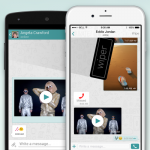
Today, there is a messaging service for just about anything and anyone. The core features are pretty much the same across the board, however. Where they differ is mostly in the way those features are implemented. For instance, you can chat with others using any messaging app, but not all offer encrypted conversations or delete your messages after they're received. The devil is in the details, as always.
Despite all the different options available today, there is still room for new messaging services to make their mark. Wiper is among the new up and coming players, with its main highlights being the option to delete conversations everywhere, on-demand, and provide secure HD video chats.
Brace yourself for a bumper Patch Tuesday say experts


Next week's round of Patch Tuesday updates from Microsoft is set to be the biggest so far this year with 16 bulletins in total, five of which are rated Critical and nine as Important.
Most of the Critical bulletins are for Windows components and affect a range of supported systems. Karl Sigler, Threat Intelligence Manager at Trustwave says, "If you are currently running a supported version of Windows, you will want to update as soon as these updates become available. These are some of the nastier vulnerabilities we've seen in Windows in a while".
Want to stay safe from WireLurker malware on iOS, OS X? Don't use shady app stores!

In spite of some incidents here and there, both iOS and OS X are mostly safe from malware. Obviously, that assumption only holds true assuming that users do not go out of their way to get into trouble by jailbreaking their devices and messing with cracked apps or software grabbed from shady places. It is common sense, really -- the security measures that Apple enforces can only go so far to protect users in uncontrolled environments. (The same thing can also be said in regards to Android and Windows, but that is a different story.) And if you need any more proof of just how important it is to stick to trusted sources, this is it.
In the past six months, hundreds of thousands of iOS and OS X users have been affected by the WireLurker malware family, according to security research firm Palo Alto Networks, after using Chinese third-party app store Maiyadi App Store to download OS X software. Go figure!
Backupify adds HIPAA compliance to enterprise security features

Cloud backups are all the rage at the moment, but they do raise security concerns, particularly for businesses that deal with sensitive information.
Cloud to cloud backup specialist Backupify has added some new features to its service to make it more secure. These include HIPAA (Health Insurance Portability and Accountability Act) compliance as well as new features for admins.
5 things your CIO needs to know about identity

When CIOs talk security they often use words like "firewall" and "antivirus." Here's why today's technology landscape needs a different vocabulary.
Modern businesses are more open than ever before, but that doesn't mean they are more secure. On the business side, companies are taking advantage of cloud computing by focusing on their internal competencies and outsourcing what they can to third-party vendors. On the consumer side, employees armed with devices are increasingly demanding flexible and frictionless access to data from anywhere.
Badly secured routers leave 79 percent of US home networks at risk of attack

As many as four out of five internet-connected households in the US could be at risk of attack through their wireless router.
This is among the findings of a study by security specialist Avast which found that more than half of all home routers are poorly protected using default or easily hacked password combinations such as admin/admin or admin/password.
Electronic Frontier Foundation finds Skype, WhatsApp and more are disappointingly insecure

Secure communication is something we all crave online, particularly after Edward Snowden's NSA revelations increased public interest in privacy and security. With dozens of messaging tools to choose from, many claiming to be ultra-secure, it can be difficult to know which one to choose and which one to trust. Electronic Frontier Foundation (EFF) has published its Secure Messaging Scorecard which rates a number of apps and services according to the level of security they offer.
It's a fairly exhaustive list that includes numerous well-known names, as well as several more niche products. What is concerning, however, is that many of the most popular tools -- WhatsApp, Yahoo Messenger, Skype, SnapChat, and Facebook chat -- received very low ratings for failing to protect users and their communication data.
Samsung reveals Find My Mobile is safe, far too long after vulnerability goes public

Samsung's Find My Mobile device-tracking service was revealed last month to be vulnerable to a denial of service attack, which would allow hackers to lock and wipe enrolled handsets. The media quickly jumped on this, with some pundits suggesting that users should stop using Find My Mobile as soon as possible, due to the apparent risks involved.
Samsung today finally decided to chime in, telling its customers that they actually have nothing to worry about. The vulnerability in question, Samsung says, was fixed more than a week before it went public, resulting in no user data being compromised. Well, it sure took Samsung a long time to come forward with this information, seeing as news about it started to surface a week ago.
GCHQ's uncomfortable truth about the web: 'privacy has never been an absolute right'

The head of GCHQ, the UK's equivalent of the NSA, says that the Edward Snowden leaks have helped terrorist organizations such as ISIS who have taken to the web to spread propaganda. Writing in the Financial Times, Robert Hannigan points out that ISIS is the first terrorist group whose members have grown up on the internet. He says that the group has made use of "messaging and social media services such as Twitter, Facebook and WhatsApp, and a language their peers understand" and that the security tools that have popped up post-Snowden makes the work of GCHQ in tracking communication much harder.
This might not come as a surprise, but something else that Hannigan says is likely to raise eyebrows. His assertion that "privacy has never been an absolute right" goes against the grain of what many web users believe, but he suggests that the challenges facing governments and intelligence agencies in fighting back against terrorists can "only be met with greater co-operation from technology companies".
Keep your keys in your pocket -- only you should be driving your data

Generally speaking, an enterprise data security company and a National Security Agency leaker might make for strange bedfellows. Yet, some of the controversial Edward Snowden’s comments at the New Yorker Festival have us nodding our heads -- with reservations, of course.
In his video interview, Snowden warned about the vulnerability of some popular storage and collaboration tools, calling them "dangerous services" that are "hostile to privacy". Indeed, we too find it troubling that a vendor or government agency can access (and distribute) personal or corporate information, without the consent of the data owner.
Malware on the rise, with Trojans by far the biggest threat


Not worried about malware? Provided you take sensible precautions when on the web, and have decent anti-malware installed, your chances of getting infected are relatively low, but the threat still persists and isn’t to be underestimated.
According to PandaLabs, a total of 20 million new strains were created worldwide in the third quarter of 2014, which works out to 227,747 new samples being identified every day.
© 1998-2026 BetaNews, Inc. All Rights Reserved. Privacy Policy - Cookie Policy.