Using online dating mobile apps risks leaking your personal data


One in five adults in the US aged between 25 and 34 have used an online dating site and mobile apps have opened up a new channel for these services to reach their clients. But this does raise concerns about the level of privacy and how user data is being protected.
Mobile security specialist nVisium has looked at the features in 30 of the most popular dating apps for iOS and Android. It found that 80 percent of the apps leaked personal information to third-party services and that 70 percent had issues that would allow a user's real identity to be disclosed.
Android smartphones shipping from factory with malware


Hardware being shipped with viruses or malware is not a new thing. In the past, there have been flash drives that were accidentally infected at the factory and made it into customers' hands. However, in the new age we live in, where nothing can be trusted, there becomes an increased paranoia in trusting hardware. There is no telling what backdoors or spy software is installed by foreign governments to spy on US Citizens. Hell, the US Government could do it too!
Sadly, it seems Android phones are being shipped pre-loaded with malware according to German security company G Data Software. Before you panic and throw your phone into a lake, please know that so far, this is only discovered to exist in Europe on what seems to be a clone of the popular Galaxy S4. In other words, if you are in the USA you are probably safe -- for now. However, there is no telling where else the trojan Android.Trojan.Uupay.D may secretly be residing.
Avast's new Android app removes ransomware from infected phones and tablets


Of all the malware threats out there, ransomware is arguably the nastiest. It locks your computer, encrypts your files, and then demands payment to free your data. You can remove it easily enough, but doing so won’t get you your files back. And unfortunately ransomware is beginning to make its way on to Android devices.
Avast has just released a Ransomware Removal app which will eliminate this type of threat from infected Android phones and tablets. It scans your device, tells you if you’re infected and if you are it will remove the malware and (according to Avast) decrypt your hijacked files.
BlackBerry brings protected messaging to the enterprise

One of the major concerns of mobile use in the enterprise is keeping company data secure. BlackBerry Messenger (BBM) already offers a reliable messaging service with millions of users worldwide, but now with the launch of a new service it lets employees benefit from speedy, reliable and private business communication.
The new BBM Protected service offers enhanced security for messages sent between BlackBerry devices by adding an extra layer of encryption to the standard BBM which encrypts messages in transit.
Comodo introduces new mobile device management features

One of the best ways for businesses to cope with the demands of mobile usage and BYOD is to use a mobile device management solution to allow the IT department to stay in control.
Security specialist Comodo has announced a range of new features to enhance its existing MDM product and make it more attractive to administrators needing to secure and manage large-scale deployments of mobile devices.
Hacker discovers a way to double your money on PayPal


A former hacker once convicted for hacking into NASA and the Pentagon claims to have found a way to reliably double your money by exploiting a loophole in PayPal's system.
Razvan Cernaianu, who goes by the nickname TinKode, claims scammers need to open three PayPal accounts in order to pull off the scam. One is a legitimate buyer, another is a disposable seller and the third is a mule. The latter accounts need to be linked to virtual credit cards.
LinkedIn to face lawsuit for spamming users' email address books


A judge in the Northern District of California has paved the way for a lawsuit against the social network LinkedIn for violating the privacy of its users. The complaint was that LinkedIn "violated several state and federal laws by harvesting email addresses from the contact lists of email accounts associated with Plaintiffs’ LinkedIn accounts and by sending repeated invitations to join LinkedIn to the harvested email addresses". It relates to the fact that LinkedIn not only used the address books of those signing up for accounts to tout for business by sending out an email to that effect, but also sent follow-up email if there was no response.
US district judge Lucy Koh ruled that while users granted permission for LinkedIn to access their contact list it is this 'spamming' that is likely to land the company in court again. The judge outlined the process users were complaining about, explaining that LinkedIn sent an email to connected in users' address books -- albeit with initial permission -- sends the same email a week later if the recipient has not joined LinkedIn, and a third email if another week passes without a signup.
The most popular stories on BetaNews this past week: June 8 -- 14

Eyes were focused on Microsoft as the company held an Xbox One press conference at E3 2014, with the focus being very much on games. Not to be outdone, Sony also held a press conference at the event. Consoles from Sony and Microsoft are still largely reliant on traditional controllers -- dull! But the SteelSeries Sentry Eye Tracker is something to, almost literally, keep an eye on as it allows for controlling games with your peepers. PS4 users have the arrival of YouTube to look forward to, and Chromecast owners will soon be able to stream files from VLC.
In security news, AVG publicized details of yet another OpenSSL flaw. While less serious than other vulnerabilities that have been discovered recently, it's still something of a cause for concern. We're still feeling the fallout of the Zeus botnet, and F-Secure set up an online testing tool that can be used by anyone to check for the infection. One tactic used to attack websites is bombarding them with comment spam, and new research shows that 80 percent of such spam is generated by less than a third of site attackers.
P.F. Chang's acknowledges loss of customer data


It seems that not a week goes by these days without news of a security breach at some company. We've seen Target, Michaels and others fall victim, though the true victims are really the customers of these establishments.
Earlier this week we heard rumors that restaurant P.F. Chang's was the latest chain to suffer a data breach. The report first came from security researcher Brian Krebs, who stated "On June 9, thousands of newly-stolen credit and debit cards went up for sale on rescator[dot]so, an underground store best known for selling tens of millions of cards stolen in the Target breach. Several banks contacted by KrebsOnSecurity said they acquired from this new batch multiple cards that were previously issued to customers, and found that all had been used at P.F. Chang’s locations between the beginning of March 2014 and May 19, 2014".
Malwarebytes Anti-Exploit available in Free, Premium, Business editions

Malwarebytes has announced the first full public release of Malwarebytes Anti-Exploit, a powerful tool which protects against many zero-day exploits. It’s now available in three editions.
A basic Free version shields some browsers (IE, Chrome, Firefox, Opera), their addons, and Java, on Windows XP or later.
FakeOFF helps you spot the fiendish Facebook fakers

Back in 2012 Facebook estimated in its official company filings that almost nine percent of the accounts on its system broke the service's rules in some way. That may not sound like many but the sheer number of Facebook users means it accounts for some 83 million problem accounts.
Some of these might simply be duplicates but others have a more undesirable purpose like spamming, distributing malware or grooming minors. Until now the only way of steering clear of the fakes was by keeping your wits about you and looking for tell tale signs like recent join dates or unfeasibly model-like profile pictures.
How to avoid threats like Cryptolocker when browsing the web

Malware has, of course, been around for ages, predating the web itself by a long mark. Indeed, the first viruses were spotted way back in the early 1970s, on networks such as ARPANET, the forerunner of the Internet.
However, as the worldwide web grew, so did the ability to more effectively spread malware. Then the explosion in social networks led to social engineering, and increasingly more sophisticated scams came about -- for example, targeted spear phishing and ransomware -- leading us to the densely populated malware landscape of today, full of big bad nasties like Cryptolocker.
Hackers try to exploit fear of Cryptolocker with spam campaign

Recent news stories, along with the UK National Crime Agency's warning that users only have two weeks to protect their computers, have raised fears about the impact of the GameOver Zeus malware and its cousin Cryptolocker.
It's not really surprising then that the bad guys are seeking to exploit these fears. Security company BullGuard has uncovered a major new spam campaign supposedly offering Cryptolocker decryption keys.
New anti-exploit tool aims to prevent your PC from getting infected
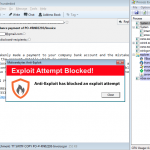
Normal antivirus software works by looking at signatures and behaviors to prevent or remove malware infections. However, many infections now stem from exploits in legitimate programs which means that it's possible for nasties to slip onto the system unnoticed.
A new Anti-Exploit tool from Malwarebytes released today is designed to protect against vulnerabilities in mass-market applications such as browsers, Java, document readers, media players and others.
Know your network

At any given time, can you see and understand the devices, applications, users, operating systems and vulnerabilities on your network? What about malware? Where is it hiding? How long has it been there? What information is it accessing?
Threats are able to circumvent and breach existing security because today’s cyber attackers often know more about a network and its protection technologies than you, the network’s owner, and use this information superiority to infiltrate and compromise networks, accessing proprietary data and risking cyber security.
© 1998-2026 BetaNews, Inc. All Rights Reserved. Privacy Policy - Cookie Policy.