ESET 7 adds exploit blocker, Twitter support

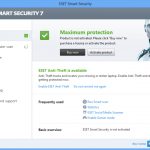
ESET has announced the release of its consumer security packages, ESET NOD32 Antivirus 7 and ESET Smart Security 7, both of which have been enhanced with some major new features.
New real-time memory scanning is a major plus, as it allows ESET to more reliably detect threats, no matter what packing or encryption tricks malware might employ.
And the winner of best security software for small business users is...


Independent testing organization AV-comparatives has released the results of its 2013 Business Software Review. This looks at security software for smaller and medium businesses, taking as its basis a single site network with a Windows Server 2012 domain controller and 25 client PCs running a mix of Windows XP, 7 and 8.
The key thing here is that this is the type of business which may not have its own IT manager so the report considers the management and monitoring of the software from the viewpoint of someone who isn't a specialist in IT and only looks after the system part time.
Windows XP users get a year of Chrome support after OS retires


It has served us well, but Windows XP is now considerably into old age; it's time to be put out to pasture. Microsoft is retiring the game-changing operating system on 8 April 2014 but this does not mean that people will not try to hang onto their beloved operating system for as long as possible.
One issue that XP diehards are going to face is support for apps. This is an old operating system, and it's not really reasonable to expect software manufacturers to keep pumping out new releases and updates. But just how long can you expect to receive updates and support? Google has nailed its colors to the mast in announcing that Chrome for XP will be supported for at least a year after Windows XP is retired.
Yahoo realizes it’s the 21st century -- plans HTTPS as default for Mail

Email encryption for Yahoo Mail may not seem like major news. In fact, Yahoo introduced the use of HTTPS as an option earlier in the year. This was not only several years after the likes of Gmail and Hotmail (and now Outlook.com), but also an optional security feature. But now security campaigners can breathe a sigh of relief; in just three short months, email encryption will be enabled by default in Yahoo Mail.
The news comes from Jeffrey Bonforte, SVP of Communication Products who says in a blog post that "at Yahoo, we take the security of our users very seriously". It will come as great news to not only Yahoo users, but also the Electronic Frontier Foundation (EFF) who wrote a letter to Marissa Mayer back in November expressing their concerns about the (then) absent HTTPS option.
At what age should children be allowed to use the internet?

The internet is an amazing tool, especially for children looking to learn. It is essentially the world's biggest library available 24 hours a day, seven days a week. But the web also has a darker side, and parents have to ask themselves the question "when is the right time to let my child go online?" Or, as Director of Online Safety at Microsoft, Kim Sanchez puts it "How old is too young to go online?".
This is a far more complicated problem than it used to be. It is not all that long ago that the average household had no more than one computer, which may not have been connected to the internet. Now, however, we live in a time when households could have multiple computers. There might still be one shared "family" computer, but it is also very common for children to have their own computer or laptop. There are also phones and tablets to think of. Pester power is an incredible thing, and it’s a strong parent who is able to resist giving into demands for a tablets when "all my friends have one".
Avast 2014 available -- new look, better protection, faster scans

Avast Software has announced the release of Avast 2014, the latest edition of its antivirus and internet security range. The new build is now available in four consumer variations: Avast Free Antivirus, Avast Pro Antivirus, Avast Internet Security, and Avast Premier.
Every edition benefits from a range of new protection features. There’s enhanced streaming updates for real-time detections; a new DeepScreen technology helps the program make smarter decisions about unknown files; extended cloud scanning again assists in detection; and if something does turn up, then improved cleaning will get rid of it more reliably.
BullGuard Internet Security gets improved detection and a better interface

Security specialist BullGuard has launched what it's calling its most advanced Internet Security suite yet. It's designed to offer industry leading protection regardless of the user's ability and to run quietly and efficiently in the background.
Aside from dropping the year from the product's name, highlights of the latest version include an enhanced behavioral detection engine to guard against zero day threats, a revised user interface offering easier one-click access to functions, free 24/7 support and free upgrades to newer versions.
Emsisoft releases Online Armor 7

Emsisoft has announced the availability of Emsisoft Online Armor 7.0, the latest edition of its versatile firewall. The update doesn’t bring any new features, and instead optimizes the program’s existing features for enhanced usability, protection and performance.
New support for asynchronous connection handling means existing connections will no longer be blocked if you have a pending firewall alert, for example.
Google updates terms of service -- can use your online activity for advertisements


As Google's involvement in our lives increases, monitoring any and all changes in the terms of service becomes important. For the most part, I am guilty of not reading long terms and conditions and other small print. I tend to base my trust in a company on experience. Largely, my experience with Google has been very good. However, since the company was named in the PRSIM scandal, I have been a bit less trusting of not only Google but online services overall.
Today, Google updated its terms of service and, by and large, it is innocuous. However, one aspect of it has given me a reason to pause, and I warn you to do the same. You see, Google plans to use your online activity to target advertisements at your Google+ circles. For example, lets say you use Google+ to like a product online with a +1. Google can then share your endorsement with your friends, family and co-workers. The search-giant calls this "shared endorsements".
Kaspersky 2014 gets 'Patch B' release, essential for forthcoming Windows 8.1


Kaspersky has released updated installer versions of Kaspersky Internet Security 2014 and Kaspersky Anti-Virus 2014. Both updates include the recently rolled out "Patch B", which adds support for Windows 8.1 and Firefox 23/24.
The update also fixes a number of bugs, but previously had to be installed separately after installing KIS 2014 or KAV 2014.
Websites use device fingerprinting for secret tracking

We all realize, or should do, that whatever we do online leaves a trail. Usually this is in the form of cookies or other information over which we have some control and which is subject to a degree of legal regulation, but what about other, more insidious, forms of tracking?
New research carried out by Netherlands-based university KU Leven reveals that a small number of sites are secretly tracking their users. The study by KU Leuven-iMinds researchers has uncovered evidence that 145 of the Internet's 10,000 top websites carry out tracking without the knowledge or consent of their users. The sites do this by using hidden scripts to extract a device fingerprint from users' browsers. This technique avoids the legal restrictions imposed on the use of cookies as well as ignoring the Do Not Track HTTP header. The study's findings suggest that secret fingerprinting is being used to get around legitimate barriers to tracking.
Skin and protect your Nexus 7 [Review]

The Nexus 7 has gone down well with the team here at BetaNews (despite a few teething problems) and it's proving popular with a lot of other people as well. Part of the tablet's appeal is that it offers great value for money. But just because something is relatively cheap, it does not mean that it should not be looked after.
Whatever phone or tablet you have, there are countless protective skins to choose from and also various ways in which to stamp your mark on your mobile device. With a couple of Nexus 7's (Nexi?) to take care of, I thought I'd take a look at some of the options that are available. The official sleeve has been available for a while and the official case has been unveiled. At $50 it's worth seeing what else is out there as well.
Sleeping with your smartphone? You should use protection

Many of us are so attached to our mobile devices that we take them to bed with us, but we're failing to take basic security precautions. This is among the findings of the 2013 Norton Report.
The report shows that whilst the number of online adults who have experienced cybercrime has fallen, the average cost per victim is up by 50 percent. In the UK, however, the cost per victim has fallen, down from £144 in 2012, to £101 in 2013.
Microsoft remains 'fully committed' to protecting customers from malware


There’s no question that Windows is a lot safer now than it used to be, thanks to Microsoft adding features like automatic updates, SmartScreen, and Windows Defender to its operating systems. I wouldn’t fully trust the built-in protection as my sole line of defense, but installing security software is no longer the very first thing I do on a new PC.
Dennis Batchelder, Partner Group Program Manager for the Microsoft Malware Protection Center, says that Microsoft remains fully committed to protecting its consumer and business customers, and highlights some of the things the company is doing behind the scenes to keep users safe.
Webroot SecureAnywhere adds new detection engine, real-time antiphishing

Security vendor Webroot has announced the release of the latest updates to its SecureAnywhere product range. And while the new builds are officially described as the rather low-key "version 8.0.4.17", this is no minor upgrade: with more than 4,000 improvements across the product, many significant, it’s effectively Webroot SecureAnywhere 2014.
One particular highlight sees all SecureAnywhere editions now including real-time antiphishing. There’s no reliance on database checks to figure out whether a site is safe; SecureAnywhere analyses sites as you access them, automatically detecting and blocking anything dangerous.
© 1998-2026 BetaNews, Inc. All Rights Reserved. Privacy Policy - Cookie Policy.