NSA phone tracking to be scaled back, says official


The NSA expects to scale back its phone tracking program in the near future, the agency’s director says. The comments came as part of a broader hearing in front of the House Intelligence Committee over the recent disclosures of NSA activities.
Director Gen. Keith Alexander told California Rep. Adam Schiff during questioning that his agency and the FBI are reviewing how the phone tracking program might be changed. Currently, the NSA asks only for the metadata -- general information about the call like phone numbers, duration, and location -- whether the person is suspected of terrorism or not, and en masse.
Snowden and the NSA reflect a millennial climate change


Snowdon (not Snowden) is the name of the tallest mountain in Wales and while by Swiss or Colorado standards it may not seem like much the weather on Snowdon is unpredictable and has taken many lives. I climbed Snowdon as a schoolboy with my class and that day on the mountain another school group was lost in a blizzard and some boys died. This is what first came to mind when I heard about National Security Agency contractor Edward Snowden leaking documents and fleeing to Hong Kong. Like his namesake mountain, this Snowden is trouble for those who are overconfident or unwary.
I’ve written about this general topic many times over the years and doing a search here and at PBS will yield a great deal that I’d rather not have to repeat. We’ve been here before. Maybe not so much in terms of there being a whistle-blower or a traitor (your choice of terms -- I’d say whistle-blower), but these surveillance programs are either old hat or logical extensions of what came before. I’m not defending them, I’m saying we shouldn’t be surprised they exist.
Symantec updates Norton 2013 range


Symantec has updated its suite of Windows security products with the release of Norton Antivirus 2013 v20.4, Norton Internet Security 2013 v20.4 and Norton 360 2013 v20.4. Version 20.4 is primarily a bug-fix release, with some notable fixes, but also tweaks the user interface.
One visible change for users who also have Malwarebytes Anti-Malware Free installed as additional protection is a fix that prevents Norton from blocking or flagging up MBAM as incompatible.
Oracle fixes the latest 40 Java security flaws


In the continuing race to the bottom between Oracle Java and Adobe Flash, the Java maker moves ahead...or is it behind? Today the company rolls out a series of patches for 40 different flaws. A pre-release announcement tells of the fix, but does not provide much in the way of information about the content of its patch updates before the fixes are posted.
"This Critical Patch Update is a collection of patches for multiple security vulnerabilities in Oracle Java SE", according to Oracle. "This Critical Patch Update contains 40 new security vulnerability fixes. Due to the threat posed by a successful attack, Oracle strongly recommends that customers apply Critical Patch Update fixes as soon as possible".
Growing popularity of OS X attracts cybercriminals


Security specialist Kaspersky is warning of the increased vulnerability of Mac systems to malware. It points out that there are now more than 63 million OS X users in the world and that since 2010 the number of antivirus signatures for Macs has increased more than six times.
The top five threats include becoming part of a zombie network via a compromised WordPress site, fake antivirus products like MacDefender and MacGuard, exploitation of software vulnerabilities, targeted attacks and network infections.
Microsoft’s EMET 4 adds even more malware-blocking power

Microsoft has announced the final release of version 4.0 of the Enhanced Mitigation Experience Toolkit (better known as EMET, fortunately), a powerful tool which can help to block exploits malware will commonly use to infect your PC.
The most immediately obvious change is a new focus on ease of use. EMET still isn’t for PC novices, but a new Configuration Wizard does help to get the program set up quickly, while an extended interface gives speedy access to the program’s various features.
It's tough at the top for anti-virus products

Results of independent tests by AV-Comparatives looking at the real world protection offered by leading packages show that competition is as fierce as ever.
The tests use 569 real-world malicious URLs. 138 of these are blocked by a Windows 7 system with all its patches up to date, leaving 431 to be intercepted by security software. The tests use MS Security Essentials as a baseline providing a 95.4 percent level of protection. You can see the full results on an interactive chart but it’ll come as no surprise that it's all pretty close.
Sandboxie adds full 64-bit protection, improves compatibility
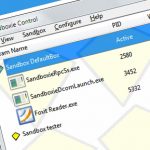
Sandboxie 4.02 is the latest edition of the powerful shareware sandbox, which allows you to run programs in an isolated environment where they’re unable to affect your main system.
The new build enhances security by dropping the use of unofficial kernel hooks. Programs running under Sandboxie now have no permissions and can’t access or manipulate any objects out of their own memory space.
Find out how safe your PC is with OPSWAT Security Score
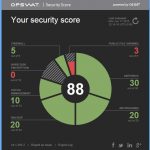
OPSWAT has released the final version of its free Security Score product, a simple tool which scans your PC, reports on any security issues it finds, and provides basic advice on how to resolve them.
The program is exceptionally easy to use. There’s no complex interface to figure out, no settings to consider, almost nothing to do at all: just launch Security Score, it scans your PC, and returns with the details in just a few seconds.
Lock out autorun viruses with NTFS Drive Protection

USB keys are a cheap and convenient way to carry important files around. Unfortunately they’re also common carriers of autorun viruses, which write themselves to the drive in an attempt to infect other systems. The risk can be reduced by turning off autorun, if it’s not disabled already (and it will be on most modern PCs), but for extra security you might prefer NTFS Drive Protection, which prevents anyone writing to the drive at all.
The program is compact (a 642K download), portable and easy to use. Launch Ntfs Drive Protection, select your USB drive in the "Target Drive" box, click "Start Protection" -- and that’s it. In just a few seconds the program will change your file and folder permissions, and no-one (not even you) will be able to add new files to the drive, or edit what’s already there.
Tech companies reveal details of NSA data requests

In the light of last week’s PRISM revelations the major tech companies have all been quick to deny that they allow the NSA direct access to their servers. But they have also said that they respond to lawful requests for data and have been revealing the numbers involved.
Apple says it received between 4,000 and 5,000 requests from US federal, state and local law enforcement agencies for customer data between December 1, 2012 and May 31, 2013. In its press release Apple says, "Regardless of the circumstances, our Legal team conducts an evaluation of each request and, only if appropriate, we retrieve and deliver the narrowest possible set of information to the authorities. In fact, from time to time when we see inconsistencies or inaccuracies in a request, we will refuse to fulfill it". Apple also says that certain types of data such as iMessage and FaceTime conversations along with Map searches and Siri requests are not retained in an identifiable form.
Edward Snowden -- A fine line between hero and traitor

The South China Morning Post is the next stop on Snowden’s media tour. Not to discuss the NSA’s surveillance on American citizens, but the agency’s work in China. You read that right, that’s not a typo.
Snowden tells the (semi) independent Hong Kong paper that the NSA’s PRISM program is used against companies and people within China, and that the US government is and has been hacking into computers in both China and Hong Kong for at least four years.
Panda Cloud Antivirus adds Data Shield, Parental Control and Rescue Boot creator

Bilbao, Spain-based Panda Security has released Panda Cloud Antivirus Free 2.2, a major new version of the company’s cloud-based antivirus tool. Version 2.2 adds a number of notable new features, including protection against data theft through malware infection and parental control tools.
The new version also bundles a bootable rescue creation tool and also adds support for access in Safe mode, ensuring it’s more capable of dealing with stubborn malware that proves hard to shift or even cripples the user’s PC entirely.
We see no threats, companies in denial over security

Network security specialist Lancope has released the results of a survey showing that 66 percent of large organisations said that either they hadn't experienced a security incident in the last 12-18 months or were unsure if they had.
Businesses face a constant stream of threats from the normal phishing and malware to more sophisticated, targeted attacks. But Tom Cross, Lancope's director of security research, says that it's very unlikely that none of these organisations experienced incidents during that time frame: "Any system you connect to the Internet is going to be targeted by attackers very quickly thereafter. I would assert that if you’re unsure whether or not your organisation has had a security incident, the chances are very high that the answer is yes -- and this is a significant problem".
Smartphone kill switch -- an evil theft deterrent


On June 13, 2013, a coalition of law enforcement, consumer groups and political leaders named “S.O.S” (Secure Our Smartphones), called for a “kill switch” to be installed in every smartphone. The concept of this kill switch is simple -- when a smartphone is stolen, the owner can have the device permanently disabled. Approximately 1.6 million people in the USA had a mobile device stolen in 2012 and a third of all robberies involves a stolen cell phone -- it is a serious problem. The hope is that overall smartphone theft would be reduced as a disabled device would be worthless.
While the concept makes sense from a law enforcement standpoint, the possibility of misuse and abuse is astronomical and threatens our liberty and freedoms. Once the kill switch is built into these devices, we lose a certain level of autonomy. There will be the potential for a government agency (domestic or foreign), corporation or hackers to disable our devices by using this kill switch for evil purposes. In other words: who will control the kill switch?
© 1998-2026 BetaNews, Inc. All Rights Reserved. Privacy Policy - Cookie Policy.