LastPass won't let 'anomaly' pass, forces users to reset passwords


Users of the free browser add-on LastPass, which offers secure online password and form management, have found themselves forced to change their master password. This follows an announcement by LastPass after it detected an unexplained "anomaly" in one of its machines' network traffic logs.
After failing to adequately explain the cause, LastPass has taken a "worst-case scenario" approach to the anomaly, assumed it represents some form of security breach -- the amount of data transferred was large enough to have contained enough sensitive information to have enabled any hacker to attempt to brute force insecure passwords -- and triggered a mandatory password change for all users.
PSN Hack: Fun and games don't have to end when someone breaks in

Hard-core players hate to lose games. But what happens when they're the sport -- the object of play? That increasingly is the state of PlayStation Network subscribers, following a hack that swiped personal data. If that's you, there are ways to protect you now and from future data theft anywhere on the Internet. Fun and games don't have to end when someone breaks in.
It all started so innocently. Two weeks ago, PlayStation Network went down. The next day, Sony promised the outage would last for a "day or two" to the despair of the fun-loving millions who use the service to access multiplayer games, movies, music and other downloadable entertainment. At the time, Sony raised the possibility that a hacker instigated the outage, but it took six days and outside help before it was revealed that PSN had indeed been the victim of a hack -- one that compromised the personal data of as many as 77 million customers. Today, new details emerged that, despite denials, Anonymous may have been responsible for the hack and data theft.
As Sony struggles to get PSN back up, new details emerge


With the PlayStation Network expected to be back up within a matter of days, Sony's statements to a US House subcommittee seem to point the finger on responsibility back at hacktivist group Anonymous, which initially denied involvement.
PlayStation chief Kazuo Hirai told Congress in a letter that the company was a victim of a sophisticated attack. As part of the hack, a file was planted on the company's servers named "Anonymous" with the words "We Are Legion." He said the company understood the full scope of the attack by April 25, but could not rule out the compromising of credit card data.
Find shared files' hidden metadata before hackers do

Document metadata can be very useful on your own PC. Tag yourself as the author of a report, say, or enter some relevant details in its description, and the file should be much easier to find later. When you need to share documents online, though, it's a very different story. Without knowing it, you could be giving all kinds of information away to hackers: usernames, network details, email addresses, software information and a whole lot more.
So does any of this apply to you? Manual checking is tedious, and could take a very long time, but, fortunately, it isn't necessary. FOCA Free is a simple tool that automates the process of checking any websites for metadata issues, and it's both quick and easy to use.
We got Osama bin Laden so that malware alarmists can get you

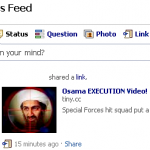
In the light of [NAME OF NEWS EVENT] we are cautioning users to beware of Internet scams and other abuse. Be on the lookout for Facebook messages related to [NAME OF NEWS EVENT], scrutinize search engine results related to [NAME OF NEWS EVENT] and look out for new domain names using [NAME OF NEWS EVENT] to attract your attention.
Oops, sorry folks! I filed my template without filling it in first. My bad.
Sony Online Entertainment also hacked, credit card data stolen
Sony disclosed on Monday that the continuing investigation into the hack of the PlayStation Network had turned up new problems: its Sony Online Entertainment multiplayer game service was also hacked, and credit card data and bank information obtained.
Monday's news just adds insult to injury for the Japanese company: at a press conference on Sunday PlayStation chief Kaz Hirai disclosed that the credit card details of nearly 10 million PSN users may have been compromised, and today the company admitted that the "encryption" of the credit card data it claimed existed earlier was nothing more than a weak hash algorithm.
Despite Sony's claims, PSN hackers may have credit card numbers

The question of whether or not PlayStation Network users' credit card information had indeed been compromised was still unanswered Friday, closing in on two weeks after the breach had occurred. On the one hand, Sony was telling customers it had "no evidence" of the data being taken, but press reports suggest otherwise.
Trend Micro senior security researcher Ken Stevens tweeted that a purported database with PSN users' personal data was apparently up for sale on the web. "The hackers that hacked PSN are selling off the DB. They reportedly have 2.2 million credits cards with CVVs," he tweeted on Thursday.
USB Immunizer: Last defense against auto-run malware?

Security firm BitDefender's report for Q1-2011 highlighted autorun-based exploits as one of the most exploited PC security vulnerabilities. But there's no need to panic, just yet. The company has conveniently just released a free USB Immunizer tool that promises to address the issue.
The program is easy to use, essentially just creating an Autorun.inf folder on your chosen drive, which in turn contains additional files and a hidden folder. So if you plug the device into an infected PC, and something attempts to write a new Autorun.inf file, then it won't be able to do so. Or, at least, that's the plan.
Sony: "We know you are upset" that PlayStation Network is still down


In the 24 hours since Sony informed the world that PSN had been hacked, customers are finally getting useful information about the hack and risk to them. Clearly, Sony is trying to quell fears about the privacy risk posed to as many as 77 million subscribers.
Today's update was a Q&A, labeled #1, so more may be coming. The post responds, in part, to questions PlayStation Network subscribers asked in comments to yesterday's shocking post admitting hackers had stolen massive amounts of data -- account names and passwords, addresses and phone numbers, birth dates and security questions. Exactly how did the hackers get so much information?
Protect your kids from Facebook stalkers and cyberbullies with SocialGuard

CheckPoint Software has introduced a new member of its ZoneAlarm product family. ZoneAlarm SocialGuard has a narrow focus: its sole aim is to monitor children's Facebook accounts in order to alert parents to suspicious activities such as cyberbullying, Internet grooming and inappropriate content.
SocialGuard works alongside existing security software, including ZoneAlarm's own free firewall software, to provide real-time alerts should potentially dangerous activity be detected on up to five monitored Facebook accounts. The parent can then review the alert and take whatever action he or she deems to be appropriate.
Thanks for giving up my identity to hackers, Sony

For as many as 77 million PlayStation subscribers, Sony delivered grim news today: Not only is PlayStation Network still down, but hackers obtained users' personal information, including logins and passwords. Credit card numbers and expiration dates "may have been obtained." That "may have" is a polite way of saying probably did.
Not only has Sony taken six days to come clean but PSN is still down, so subscribers can't log in to change their compromised information. That's what I wanted to do right away, if for no other reason than a sense of control and security. That Sony can't, or won't, bring back PSN says something extraordinary about the potential scope of the breach.
With PSN still down for sixth day, Sony admits data loss
The worst fears of many PlayStation Network users were realized on Tuesday, as Sony finally admitted that the hack of the online service last week did indeed involve some type of data loss. The disclosure marks the first time since the debacle began that the public got a clear picture of what the hackers were after.
Sony said it believed at a minimum information including name, address, e-mail, birthday, and PSN login information were obtained. It also said that it was possible that both purchase history and also credit card information may have been compromised as well, although not the security code. An outside security firm was hired to investigate what happened.
Sony: Can't say if PSN hack put personal info at risk
With the PlayStation Network outage now in its fifth day, concerns have begun to mount that the hack that took the online gaming network offline may have involved some type of data loss. Sony representatives continued to stay mostly mum, only willing to confirm that an "intrusion" had indeed happened.
In an interview with IDG News Service, Sony Computer Entertainment spokesperson Satoshi Fukuoka said that the company had not determined whether or not sensitive information had been compromised. Fukuoka said that if the company did find evidence of such an issue, users would be notified "promptly."
Kidnapped Kaspersky son freed in raid; no ransom paid

Kaspersky Lab has issued a statement Sunday confirming earlier reports that Ivan Kaspersky, son of CEO and founder Eugene Kaspersky, had been kidnapped and subsequently freed. Ivan Kaspersky was freed in an "operation" by the authorities and no ransom was paid.
The statement in full follows: "Kaspersky Lab confirms that an operation to free Ivan Kaspersky was carried out successfully by the Federal Security Service (FSB), the Criminal Investigation Department of the Moscow Police and Kaspersky Lab's own security personnel. Ivan is alive and well and is currently located at a safe location. No ransom was paid during the rescue operation. Eugene Kaspersky and Natalya Kaspersky are currently unavailable for comment."
Eugene Kaspersky is one tough guy

The security community deals with disturbing news all the time, but none so disturbing as the reports that the son of Eugene Kaspersky, founder and CEO of Kaspersky Lab, has been kidnapped (and now reportedly freed). Russia is a tough place.
The Western stereotype of a Russian businessman is a politically-connected tyrant who probably only got his business through corrupt means. Not Yevgeny "Eugene" Kaspersky; I don't really know much about how he built his business, but I do know that his company has developed high-quality, respected security products that sell really well in the West. He's a genuine engineer, who worked on his own products until the company got too big for that to make sense. You can't do that by bribing public officials.
© 1998-2026 BetaNews, Inc. All Rights Reserved. Privacy Policy - Cookie Policy.