Imation IronKey Workspace W500: Secure Windows To Go drive for enterprise users [Review]


In the modern workplace there’s increasing demand for people to be able to work remotely or bring their own devices into the office. That presents a problem for IT departments who need to deliver secure access to corporate data and ensure that everyone is using approved applications.
One way of allowing employees and contractors to use their own PCs but still ensure they’re running the approved corporate software is the IronKey Workspace. It’s a bootable USB stick that can be loaded with a corporate Windows image including applications, security controls and access policies. It will work on any reasonably modern PC and on some Macs too.
Ditch the Slow Ring! Get on the Windows 10 Fast Ring or step away from the previews


Windows 10 is a major departure from the norm for Microsoft. This is not only the first time Windows has been made available as a free upgrade, but the first time that users have been able to get actively involved in the development process. The existence of the public previews for Windows Insiders has made this one of the most transparent development programs to come out of Redmond.
Broken down into the Fast Ring and the Slow Ring, Microsoft has explained how the Windows 10 development process works, saying that the former is for those who want to be on the bleeding edge, the latter for those who want to play it safer. Ultimately, however, you should be either in or out, and this leads us to the question: what's the point of the Windows 10 Slow Ring?
Worried about Windows 10 privacy? Use Linux


Windows 10 is a wonderful operating system. Every day, I boot a computer running Microsoft's latest operating system to get work done. On the surface, everything is peachy-keen. Sadly, under the hood, there are some legitimate privacy concerns. There is a bunch of information being sent to Microsoft, and you may not even know it. This has caused programs like the wonderful O&O ShutUp10 to be created.
Luckily, Windows is not the only game in town, folks. Actually, there are many wonderful operating systems available to you at no charge. Unlike Windows 10, where it is only free with a prior licence, most Linux-based operating systems are entirely free. Period. If you want to try one of these open-source operating systems, you may be confused as to where to start. Don't worry, I am here to help. Here are the distributions and software you should use.
Windows 10 Insider Preview Build 10547 arrives with improvements to Start, Tablet Mode and more

Microsoft has released Windows 10 Insider Preview Build 10547 for testers on the Fast ring. The build comes with a number of new features and tons of improvements to Start, Microsoft Edge, and Tablet Mode, among others. Let's dive into it.
Beginning with Start, the company is now allowing users to add a 4th column of medium-sized tiles to it. Until today, users could only have three medium-sized tiles. This adjustment will also allow users to add two large-sized tiles side-by-side if that's what they want.
Windows 10 is not Bing's savior


You would think that, as Windows 10's adoption takes off, Bing's market share would follow suit. The search engine is an integral part of the new operating system, being used, for instance, in Cortana and the new default browser, Microsoft Edge. Yet, since Windows 10's debut on July 29, Bing is no more popular than before.
According to a new report by comScore, Bing's US market share has seen only a modest increase on a sequential basis, rising to 20.6 percent in August 2015 from 20.4 percent the month before. The volume of queries increased by just one percent in that time-frame.
Why Mark Wilson is wrong about Windows 10


My colleague, Mark Wilson, just posted a list of the seven things he "still hates about Windows 10". And while I feel his pain -- I have my own pet peeves with Microsoft’s latest and greatest -- I found many of his complaints are misguided and/or shortsighted.
In a lot of cases he's just nitpicking and I think he’s missing the bigger picture.
Fix Windows 10 problems with these troubleshooting tools from Microsoft


Upgrading to Windows 10 from either Windows 7 or 8.1 should go smoothly and be relatively painless afterwards, but we know from the enduring popularity of features such as How to fix Windows 10's worst problems that it often isn’t the case.
Microsoft also knows that upgraders are encountering all sorts of issues with the new OS, and so has put together a selection of automated troubleshooters designed to fix problems you might be having post-upgrade.
AVG's new privacy policy is brutally honest about tracking you

AVG has thrown down the gauntlet to other technology companies, challenging the rest of the industry to produce open, truthful privacy policies. AVG has done just that, and you might not like what you read.
The antivirus company has published its own brutally honest privacy policy that clearly sets out how it tracks users' activity, gathers data, and shares that information with others. Unsurprisingly, despite the fact that nothing has changed but merely been brought out in to the open, people are not happy. Is honesty about a disagreeable policy better than living in blissful ignorance?
The real reason why you’ll never get Windows 10 on your Surface RT tablet
"What Intel giveth, Microsoft taketh away". That was the mantra my colleagues and I adhered to when I was leading Intel’s PC benchmarking efforts in the early 2000s. As the resident "HOC" (Highly-paid Outside Consultant) to the company’s Desktop Architecture Labs (DAL), my job was to help Intel’s engineers design the most complex desktop runtime environments possible for the purpose of showcasing the performance advantages of each new PC chip generation. And thanks to a steady stream of increasingly CPU-hungry Windows and Office releases, our thirst for new and interesting stuff to stack atop our shiny new Pentium III and IV test rigs was always satiated.
Then came Windows Vista, and for the first time the CPU demands of Microsoft’s software stack outpaced the average performance of even state of the art Intel designs. Suddenly, Windows was "too fat" to fly, and the subsequent backlash saw the long overdue departure of Vista’s architect Jim Allchin, the ill-fated rise of Steven Sinofsky to Windows development boss, and the much anticipated emergence of Windows 7 as the anti-Vista: A new version that was actually less demanding (in terms of CPU, memory and disk footprint) than its predecessor.
7 things I still hate about Windows 10

Windows 10 has been with us for quite some time now, particularly for anyone who has been trying out the Insider builds since the beginning. Many people, myself included, have been disappointed with Microsoft's latest operating system but perhaps it's time to re-evaluate.
Have I got used to the things I didn’t like? In some cases, yes. But there are still a number of areas in which Windows 10 falls short of the mark. So here are seven things that piss me off about Windows 10; one for every day of the week!
Microsoft refuses to answer questions about forced Windows 10 downloads

Just last week Microsoft managed to piss off a lot of people by secretly downloading the Windows 10 installation files to their computers without permission. The comments from BetaNews readers were plentiful, but divided. Some didn't see the problem, while others thought it to be invasive and presumptive.
But there was one question that popped up again and again -- just what the hell was Microsoft thinking? I decided to try to find out but found that the company was somewhat cagey with what it wanted to say on the matter. This is not on. People are more than a little annoyed, and they are demanding answers. They deserve them.
Microsoft to announce new Windows 10 devices at October event
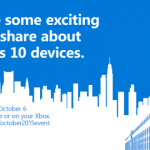
We knew that Microsoft won’t be making any announcements related to its newly released operating system during the IFA 2015 fair, but now we have more details.
Microsoft has taken to Twitter to announce it is holding a separate event on October 6 at 10 am EDT (3 pm London time) in New York.
Microsoft releases the Windows 10 UI you've always wanted -- and you can't have it!

Today is a frustrating day. On the positive side, Microsoft finally released the Windows 10 experience we’ve been clamoring for. It comes with all the goodness of Windows 8.1’s refined touch UI plus a familiar old friend: A Start Menu that retains the core of the previous versions but supplements it with some new-fangled Live Tile tricks.
The frustrating part is that most users can’t have it. In fact, unless they’re running one of the handful of Windows RT-based devices (e.g. Surface or Surface 2), they’ll never see this wonderful incarnation of the Windows 10 UI everyone wanted.
Microsoft brings the Windows 10 Start menu to Windows 8.1 RT

The return of the Start menu to Windows 10 was one of the things that Microsoft managed to get right with the latest version of its operating system. While the company has promised to bring Windows 10 to as many devices as possible, it ruled out doing the same for Windows RT devices.
That said, we were told that some key features of Windows 10 would make their way to Windows 8.1 RT. That day has finally rolled around and thanks to the arrival of Windows RT 8.1 Update 3, the Start menu is now available in Windows RT.
Windows 10: A closer look at usage numbers
Windows 10 launched globally on 29 July, with Windows 7 and Windows 8.1, as well as Windows Insiders, all receiving free upgrades to the new OS.
Microsoft suggests that Windows 10 has had great initial success with 75 million devices installing the upgrade just four weeks after it was released. The company’s marketing chief, Yusuf Mehdi, said "the operating system is being downloaded and installed faster than any previous version of the platform".
© 1998-2026 BetaNews, Inc. All Rights Reserved. Privacy Policy - Cookie Policy.