Bing brings voice search to Xbox

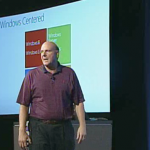
Microsoft CEO Steve Ballmer made absolutely clear today why the company continues to invest in search, even though it's a money-losing business and Google's market share is so big (and not really declining). He described Bing as a "fundamental set of core technologies" that Microsoft plans to leverage seemingly everywhere.
Earlier in the day, during the BUILD developer conference Day 2 keynote, Server and Tools President Satya Nadella gave several examples how developers can incorporate Bing datasets into their applications development. Bing isn't just about search, but about information made available for third-party applications and services and for software development.
SharePoint is 'Facebook for the enterprise'

Make no mistake. Microsoft's big development push this week is around Windows, but Office and supporting software, such as SharePoint, are more important at the bottom line. During today's Microsoft Financial Analyst Meeting, COO Kevin Turner said that the Business division "is 32 percent of the company". Windows is 27 percent and Server and Tools is 24 percent.
Microsoft typically holds FAM during July, within weeks of closing its fiscal year on June 30. But this year Ballmer and his team delayed the annual event until this week's BUILD developer conference. That's smart, because Wall Street analysts have a chance to see some new Microsoft's products, Windows 8 in particular.
Remembering Windows XP

First in a series. It was an innocent time. There was fun, fanfare and pride. Thousands of people worked together to complete something that would affect billions of lives -- that would be the most successful product of its kind. Ever. Eighteen days later the world they knew changed.
Ten years ago today, Aug. 24, 2001, in Redmond Washington, Microsoft Chairman Bill Gates and Jim Allchin, then vice president of the platforms group, officially released to manufacturing Windows XP. The RTM marked a huge achievement for Microsoft, which finally had a consumer operating system based on the NT kernel. Windows XP marked the end of the DOS/Windows 9x legacy and the beginning of a new lineage of Microsoft operating systems, continuing the path paved by Windows 2000 some 18 months earlier.
IE10: Don't cry for me, Windows Vista


Signaling that Microsoft is ready to move beyond one of its more forgettable releases, the next version of Internet Explorer that debuted at the MIX11 conference in Las Vegas earlier this week will not run on the Windows Vista operating system.
The move may be a surprise considering Vista as an operating system is a little over four years old. Support for Windows XP, launched in 2001, only ended with IE9 as the company claimed the operating system lacked the technologies necessary to operate the browser.
Windows 7 adoption surpasses Vista use, Mac OS flat
Usage of Windows 7 has eclipsed that of its predecessor Vista for the first time, data from research firm NetApplications indicates. Regardless, Windows XP remains the most commonly used operating system.
Share of Windows 7 in July hit 14.46 percent, a hair above Vista's 14.34 percent share for the month. This was nowhere close to Windows XP, which saw a 61.87 percent share, which has declined slowly over the past year as adoption of Windows 7 rises.
Windows 7 has overtaken Vista in OS share, says study

Denver-based technology research firm Janco Partners, Inc. today released a study profiling the international browser and operating system market.
The study shows that in the less than seven months that Windows 7 has been available, it has already attained a 14.8% share of the international OS market.
Technologist accused of spreading Vista, Win7 FUD wasn't a real person


Normally, Betanews doesn't like to do "inside baseball" stories, that deal with the individuals in the technology journalism business and all the insights as to "how the sausage is made." I'll try to make this one as painless as possible, but it needs to be done, because the individual involved had been cited by me in Betanews stories in the past.
Yesterday morning, ZDNet Editor-in-Chief Larry Dignan revealed the results of research showing that a blogger for IDG publications, and the CTO of a testing and research firm cited by that blogger, were actually the same person. Blogger Randall C. Kennedy, a trusted InfoWorld contributor up until yesterday, was Devil Mountain Software Chief Technology Officer "Craig Barth," the author of reports over the years claiming that Windows Vista performance was slower than Windows XP, and recently that Windows 7 performance was slower than Windows Vista.
PDC 2009: Live from the Day 2 keynote

Microsoft's Windows division president Steven Sinofsky is the headliner for today's Day 2 keynote at PDC 2009, and Betanews has its usual front-row seat.
11:04am PT: Promise of discussion on Windows Mobile at MIX '10 next March 15-17 in Las Vegas -- notice once again that the number "7" is omitted from the reference to this product. Keynote ends 35 minutes over schedule.
PDC 2009: Scuttling huge chunks of Vista architecture for a faster Windows 7

The reason Windows Vista seemed slow, and somehow, strangely seemed even slower over time, is now abundantly clear to Microsoft's architects: The evolution of computer hardware, particularly the CPU, exceeded anyone's expectations at the time of Vista's premiere in early 2007. But the surge in virtualization, coupled with the rise of the multicore era, produced a new reality where suddenly Vista found itself managing systems with more than 64 total cores.
Architects had simply not anticipated that the operating system would be managing this many cores, this soon -- at least, that appears to be the underlying message we're receiving here at PDC 2009 in Los Angeles. As independent scientists were speculating about possible performance drop-offs after 8 cores, server administrators were already seeing it. There were design tradeoffs for Windows Vista -- tradeoffs in efficiencies that could have been obtained through complex methods, for simplicity.
PDC 2009 Day 0: Vista is through

The architects who redeveloped the thread scheduling system for Windows 7 and Windows Server 2008 R2 realized that during the Vista era, they made some design decisions in favor of simplicity, especially for developers. But that simplicity came with a performance hit, especially from processes running in multicore processors -- the more the cores, the bigger the hit.
We all saw that with Vista. In overcoming these deficiencies, it's apparent from listening to the architects themselves, speaking on "Day 0" of PDC 2009 in Los Angeles (the day before the big keynotes), that they had come to loathe Vista's problems just as much as everyday users.
Bad Vista-to-Windows 7 upgrade experiences #2: No TV in Media Center
Typically when you upgrade a computer from one operating system to the very next level up, you don't want the new system replacing or deleting anything without your knowledge and approval. Windows 7 thus far seems to be quite good on this score. But perhaps it's too good in the case of its new and somewhat enhanced Windows Media Center, whose new reliance on an upstream recording prevention mechanism that's part of its PlayReady scheme, among other things, renders obsolete Vista's media settings.
As a result, if you have a TV tuner in your Vista-based PC, and you follow all the instructions for migrating to Win7, the new Media Center could insist you don't have a TV there at all. Betanews was able to reconstruct the conditions of a situation some upgraders are reporting where their built-in tuners disappear. Luckily, we also have a solution to the problem that worked for us, and that may hopefully work for you if you're in similar circumstances.
But let's concede right off the bat, it's not an easy or intuitive solution, so don't blame yourself thinking there's something you missed.
Bad Vista-to-Windows 7 upgrade experiences #1: 'Hosed' Intel SSDs

Although we had good reason to expect that most folks' experiences with Windows 7 upgrades this past week would be, as we put it, "without the crap," the exceptions are starting to show up. One of the more serious cases involves Intel, which has withdrawn its latest solid-state drive firmware update after multiple reports from disgruntled users of complete storage system failure following their Windows 7 upgrades.
The new firmware, along with Windows 7, was supposed to support a new internal file management methodology called TRIM. Its purpose was to compensate for a problem typical of memory-based storage, as opposed to traditional magnetic disks: Since memory systems must keep track of their contents even some of those contents aren't really in use, over time, SSDs' performance can lag. While traditional disks don't have to retain a memory of the contents of sectors pointing to "deleted" files, SSDs do...and they can't wipe the contents of those sectors individually. Instead, they have to wait until entire blocks become disused -- which happens less and less often as drives become more and more fragmented. TRIM was supposed to overcome that deficiency with a kind of self-optimizing mechanism, letting SSDs wipe blocks more often, thus overcoming lags and keeping performance levels high over time.
Microsoft wins round one in its battle against Vista
Anyone who would continue to frame the consumer PC market in 1980s terms, as a continuance of the old war between Microsoft and Apple, would be sorely disappointed by this morning's earnings news from Microsoft. The measured candor that continues to emerge from CFO Chris Liddell suggests that Macintosh and iPhone are not even on the company's radar at the moment, and that his real battle is against a tougher and more menacing foe: Vista.
As of yesterday, it was officially okay for Microsoft to pronounce Vista part of its past, to "un-support" it from a marketing standpoint (though certainly not from a service standpoint). Steering Microsoft clear of the perfect storm -- the effects of the global recession, coupled with the peak in negative attitude toward Vista -- means putting Vista behind it, placing it in the adversarial role normally characterized by someone who looks a lot more like Justin Long than John Hodgman.
Windows 7: Vista without the crap

Download Microsoft Windows 7 Upgrade Advisor 2.0 from Fileforum now.
Here is the essential information you need to know if you're a Windows Vista user considering whether to upgrade to Windows 7: Yes.
No, Windows 7 isn't slower than Vista, even at booting up
The manufacturer of a Windows maintenance toolkit featured on our Fileforum told CNET's Ina Fried last week that it believes boot times for Windows 7 are typically slower than boot times for Windows Vista. Iolo Technologies told Fried that it gauged the amount of time required for the CPU to reach a "true idle state."
As many veteran Windows users already know, the operating system doesn't actually boot to an "idle state" -- it's not DOS. Since that time, Iolo has been characterizing the time it stops its stopwatch as the time that the CPU is "fully usable," which seems rather nebulous.
© 1998-2026 BetaNews, Inc. All Rights Reserved. Privacy Policy - Cookie Policy.